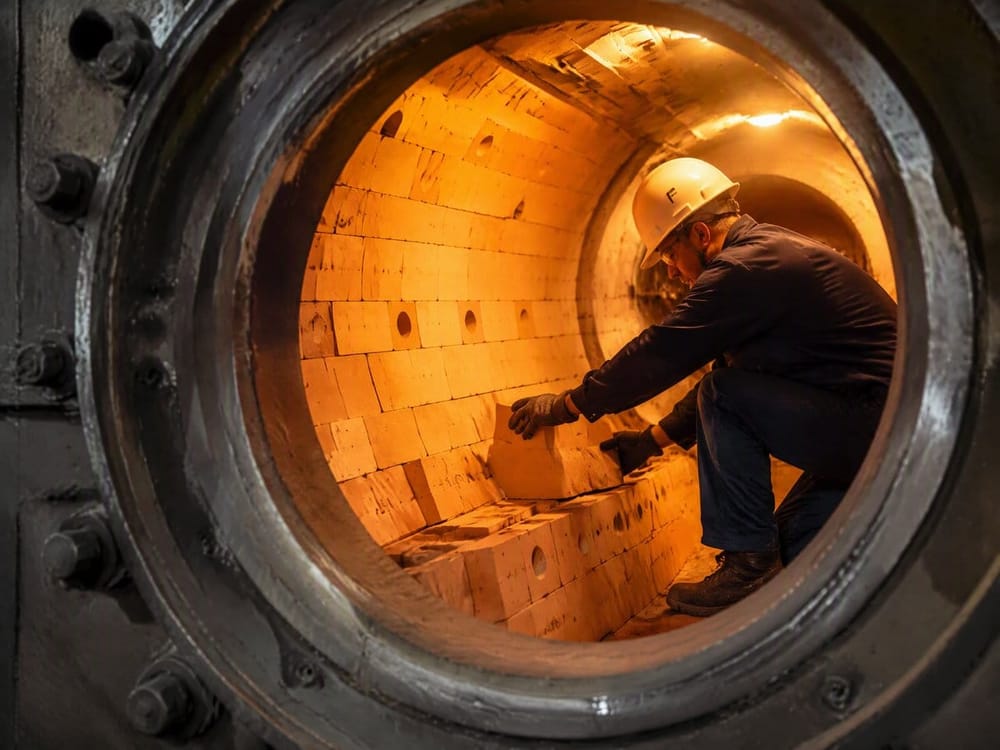
Refractories & Lining Service
A kiln lining is not just a layer of bricks. It must survive 850–950°C with steam and alkaline ash for three to five years, and absorb the thermal shock of every start and stop. When a lining fails early, the cause is usually not the brick but the expansion joints and anchors. Scope Kiln shell brickwork including special shapes, insulation design, anchor and mesh installation, castable placement, and dry-out schedule development and execution — for activation kilns, carbonisers, rotary kilns and incinerators. Three critical zones The activation zone (high temperature, steam, abrasive solids — high-alumina brick or corundum castable, judged on wear and steam oxidation; its life sets the overhaul interval for the whole kiln). Transition zones and expansion joints (different materials expand differently; joint width is calculated per material and run length, and the wrong filler cracks the brickwork). The discharge zone (steepest thermal gradient, low-cement castable with a controlled heat-up). Why dry-out cannot be skipped Castables contain 8–12% free and chemically bound water. Heat too fast and the water turns to steam inside the lining and spalls it. The standard schedule — 25–30°C/h to 150°C and hold 8 h, then 50°C/h to 350°C and hold 6 h, then follow the kiln — takes five to seven days. When to reline Any one of: shell temperature above 120°C, through-cracks at joints, or discharge opening deformed by more than 5%. Running until the shell glows costs two to three times a planned shutdown.