Products
Rotary Activation Furnace
The rotary activation furnace uses a slightly inclined drum. Char enters at the high end; the drum turns at 0.5–2 r/min and internal flights lift and cascade the material through a counter-current flow of 850–950°C steam. Residence time is set by rotation speed and inclination, typically 60–120 minutes — much shorter than a vertical Slep furnace. Capacity is 0.5–3 t/h, the widest band in the range. The drum tolerates a broader feed spectrum (granular, cylindrical, crushed) and a grade change takes a few hours of cleaning rather than the 3–5 days a vertical kiln needs. Choosing between rotary and Slep Continuous single-grade duty with heat efficiency priority → Slep. Multi-grade switching, above 2 t/h, or unstable feed size → rotary. At equal capacity the rotary unit needs more floor space and loses slightly more heat, but is far more forgiving to operate and service. Design points that decide performance Flight profile (spiral for sticky feed, sector for granular — the wrong choice causes ring formation); staged steam injection in 3–4 zones, which narrows iodine-value spread by 20–30 mg/g; discharge cooling designed to ≤80°C with margin, since running 10% over rating pushes outlet temperature to 90–110°C and breaks packing; and rotary seals at both ends, the usual source of steam loss. Yield reference (coconut shell): 6.4 t wet shell at 12% moisture → 5.6 t dry → 1.68 t char (30%) → 1.04 t activated carbon (62%) → 1.00 t product. Overall yield 15.7%, i.e. 6.2–6.6 t shell per tonne of product.
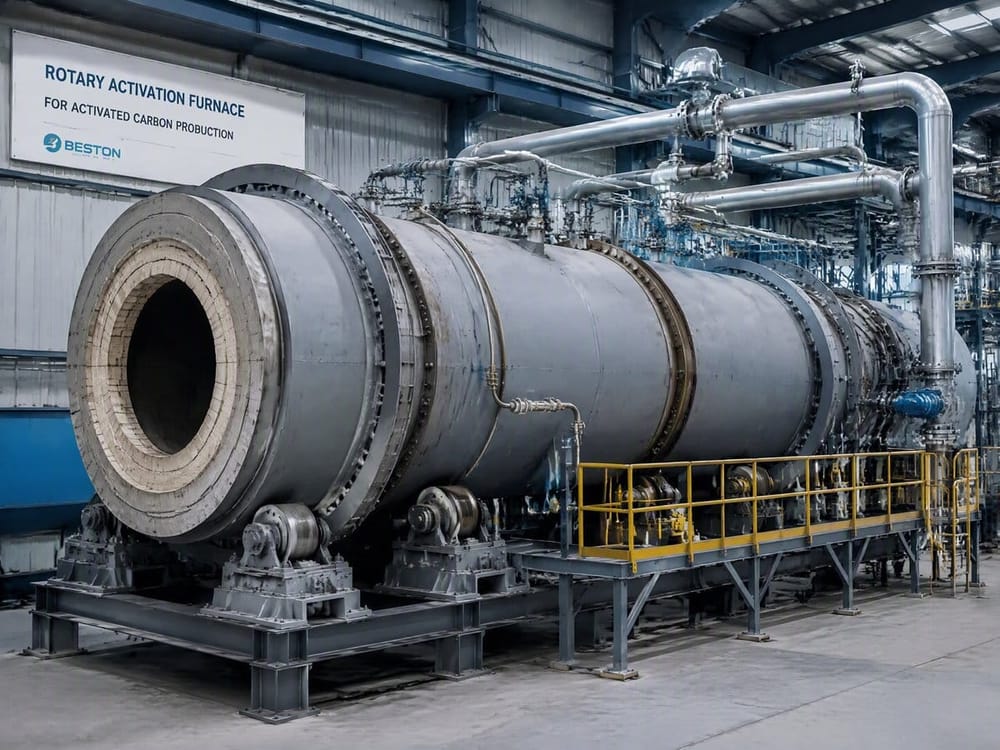
HRS Rotary Activation Furnace
Internal-heated rotary activation furnace for continuous activation of coal, wood and nut-shell charcoals, with uniform activation, large capacity and low energy consumption.
View Details →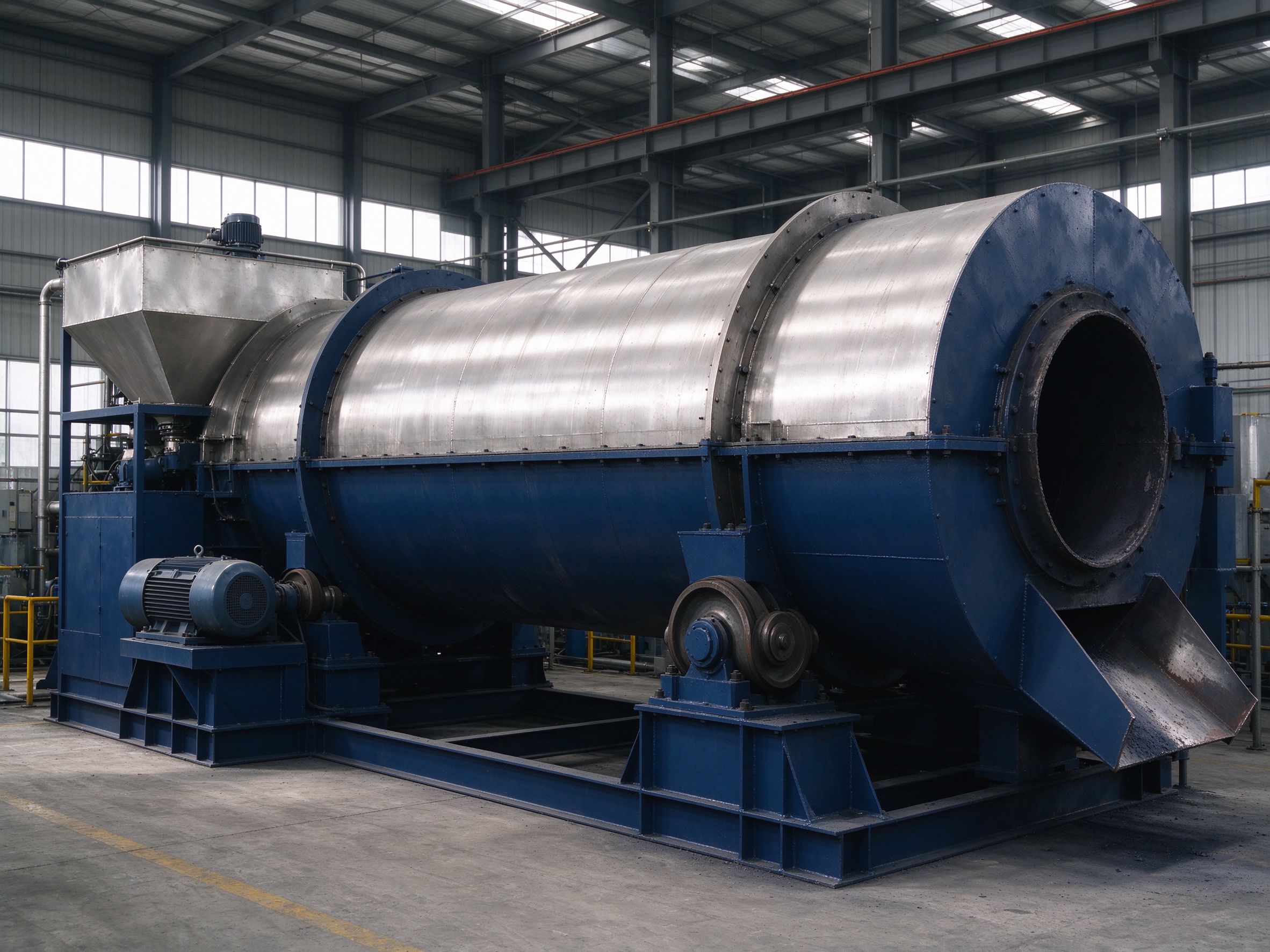
HRS Spent Activated Carbon Regeneration Furnace
Rotary regeneration furnace for spent activated carbon recovery, restoring adsorption via steam activation with high regeneration yield for water, chemical and food decolorization applications.
View Details →Slep Furnace
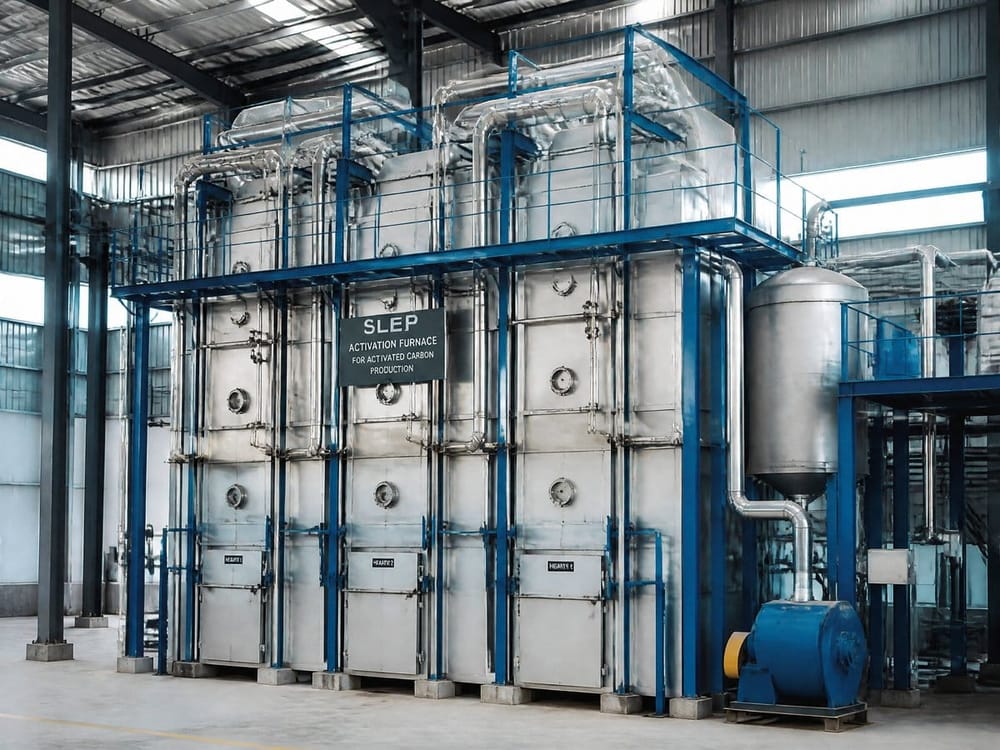
The Slep furnace (saddle-type) is a continuous vertical activation kiln. Carbonised material is fed at the top and travels downward under gravity without interruption — the process is continuous, not batch. Total residence time is 36–42 hours, of which about 30 hours are in the activation zone, where the material contacts a 850–950°C mixture of steam and flue gas in counter-current flow. The only cyclical element is heat reversal: the two regenerator banks alternate every 30–60 minutes and the gas flow reverses. The material itself never stops moving. This matters when sizing capacity and planning maintenance. Capacity and product Rated 0.5–2 t/h of finished activated carbon per unit. With coconut-shell char and an iodine value of 900–1100 mg/g, steam consumption is roughly 2.5–3.5 t per tonne of char and activation yield is 55–62%. Below 0.5 t/h the Slep design is not recommended — heat losses through the shell raise specific energy noticeably. Fit and non-fit Best for single-grade, continuous operation and granular carbon; plants with limited footprint and surplus steam. Not suitable for frequent grade changes (a changeover requires 3–5 days of cleaning) or for batch-level traceability. Four numbers to settle before quoting Annual operating hours (7200 three-shift / 4800 two-shift / 2400 one-shift); char particle size (8–20 mm, fines below 15%); steam pressure stability at 0.6–0.8 MPa; and the four finished-product specs — iodine value, methylene blue, ash and hardness — which together determine residence time.
Carbonization Furnace
Carbonisation is the stage before activation: coconut shell, palm kernel shell or nut shell is heated to 400–600°C in an oxygen-limited atmosphere to drive off volatiles and fix the carbon skeleton, producing char with initial porosity. Carbonisation yield is the first cost gate on the whole line — 28–32% for coconut shell — and it sets how many tonnes of raw material each tonne of product consumes. Furnace choice The rotary carboniser handles mixed granular and crushed feed, with three zones along the drum (drying 150–250°C, carbonisation 400–600°C, calcination 600–700°C), 30–60 minutes residence and 0.5–3 t/h capacity. Vertical carbonisers suit a single, narrow particle size and run continuously with better heat efficiency, but are sensitive to feed grading. Below 0.5 t/h, buying char is more economic than building your own carboniser. Control points Heating rate — too fast in the first zone releases volatiles in a burst, cracks the char and costs 3–5 points of finished hardness. Residual oxygen — above 2% the char simply burns, and each percentage point of yield costs about 150 CNY per tonne. Volatile routing — burning the off-gas back is what makes the carbonisation zone heat-neutral; venting wastes energy and fails environmental review. Discharge temperature — above 200°C the char self-ignites on contact with air and must be cooled below 60°C. Interface with activation Char has very low adsorption (100–200 mg/g iodine); its value is particle size and strength. Weak char cannot be turned into strong, low-ash product by any activation kiln. When buying char, check five things together: size distribution, bulk density, volatiles, ash and hardness.
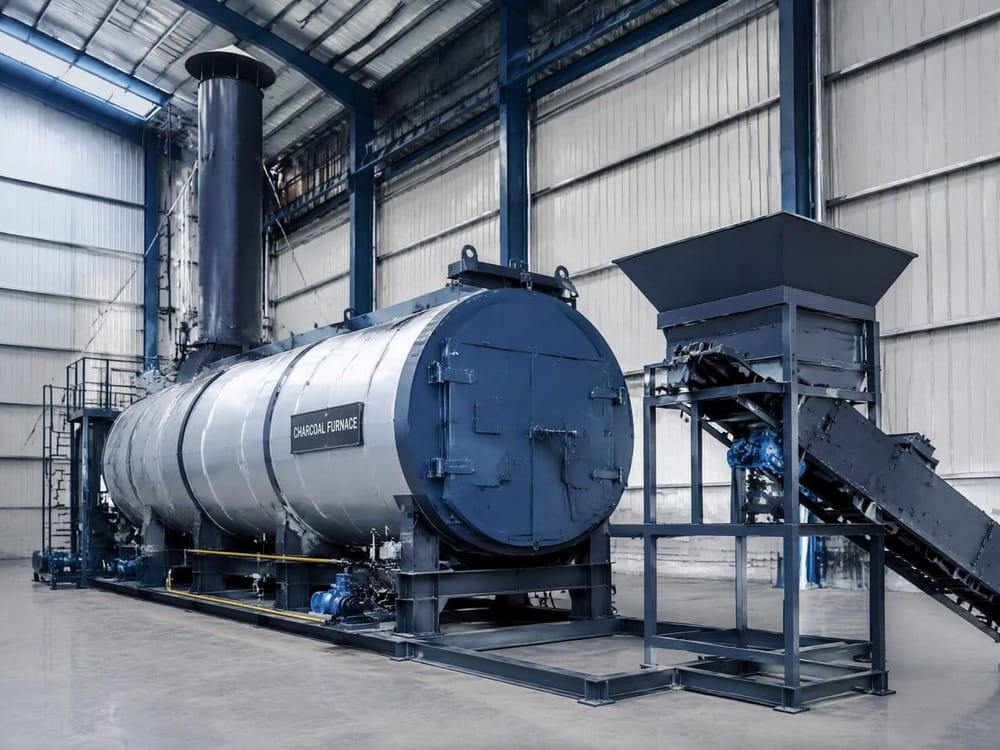
HRS Carbonization Furnace
Internal-heated rotary and vertical carbonization furnaces for oxygen-deficient pyrolysis, with high char yield and controllable flue gas.
View Details →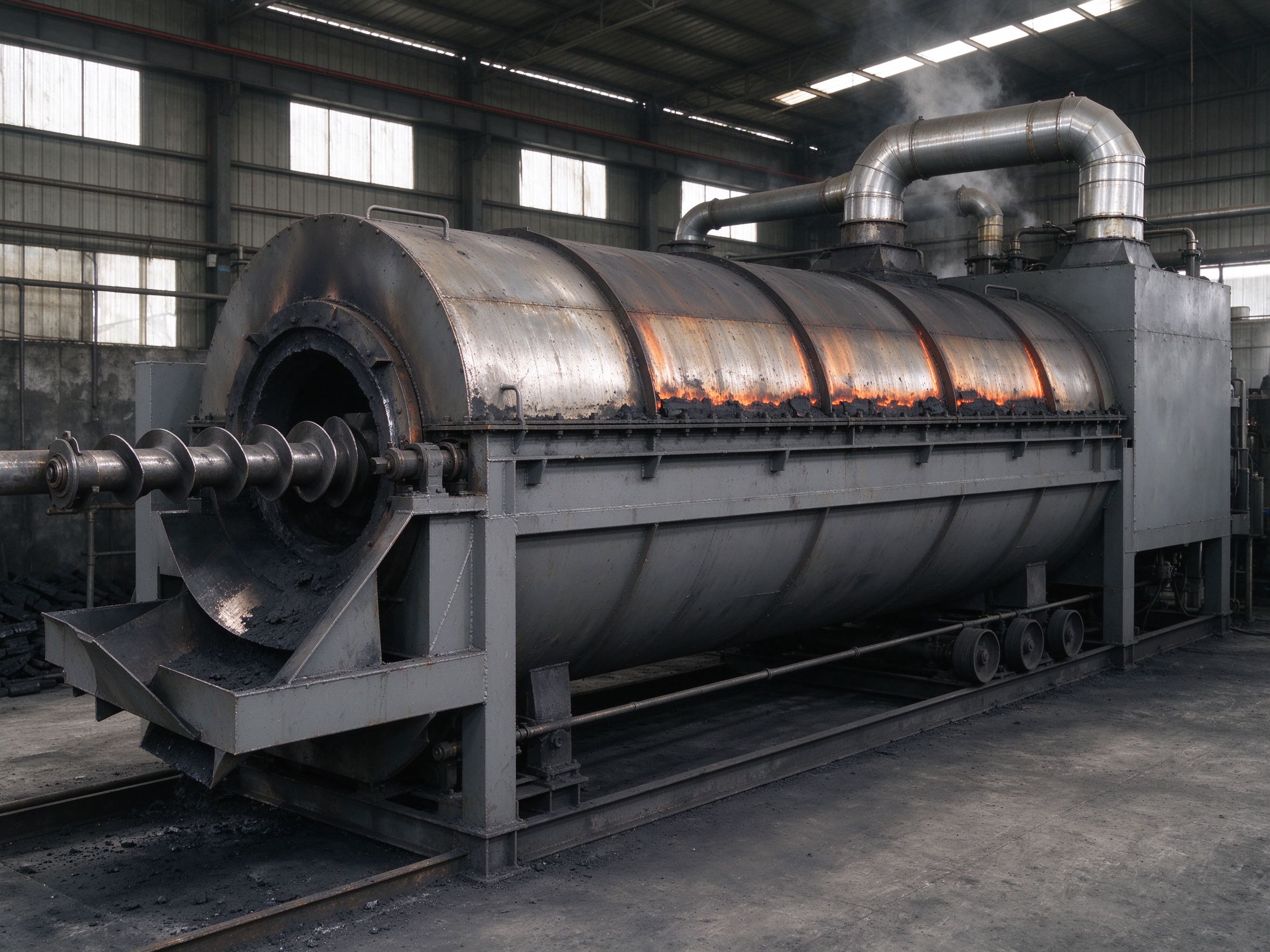
HRS Continuous Carbonization Furnace
Continuous rotary carbonization furnace for coconut, shell, wood and coal raw materials, producing uniform char for activation with large capacity, matching activation furnaces in continuous lines.
View Details →Complete Production Line
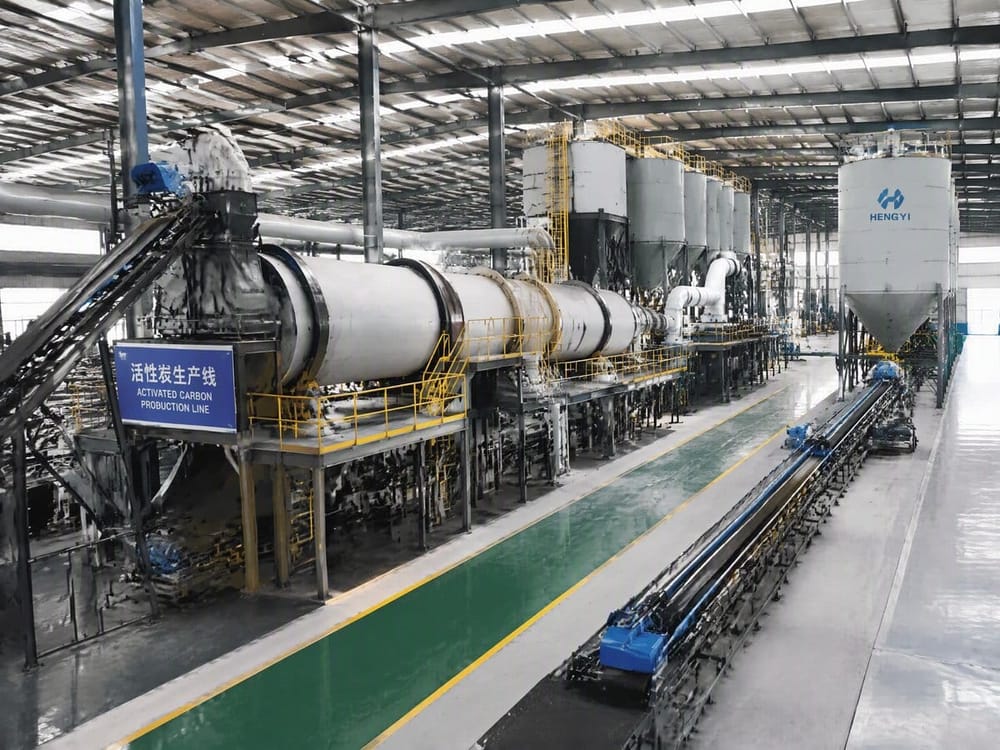
A complete production line links crushing and screening, carbonisation, activation, cooling/conveying and packing into one continuous flow. What you buy is the ability to produce tonnes of finished carbon — not a single kiln. The measure of a line is whether the stages balance and whether heat closes on itself. Capacity matching The activation kiln sets the rating; upstream and downstream carry margin: crushing/screening at 1.5×, carbonisation at 1.2×, cooling and packing at 1.3×. For 1 t/h of product: 1.5 t/h crushing, 1.2 t/h carbonisation feed, 1 t/h activation, 1.3 t/h packing. Energy basis (1 t/h coconut-shell line, measured) 267 kW installed, 208 kW running, about 210 kWh per tonne of product; 284 Nm³ of natural gas equivalent per tonne for activation steam; 375 kgce/t overall. The waste-heat boiler raises 1.8 t/h of steam, all consumed on site — no purchased steam. This single item sets the floor on operating cost; a poorly designed heat-recovery section costs 300–500 CNY more per tonne. Footprint The activation unit alone is 24×10 m; the full line with raw-material shed, carbonisation area and finished-goods store needs 45×18 m, with 8–9 m clear height at the carboniser feed end. Three common mistakes Comparing kiln prices instead of the plant mass balance; ignoring feed moisture (12% vs 25% doubles the dryer heat load and breaks heat self-balance); and specifying dust collection to the minimum environmental standard — activated-carbon dust is conductive and hygroscopic and destroys ordinary filter bags within three months.
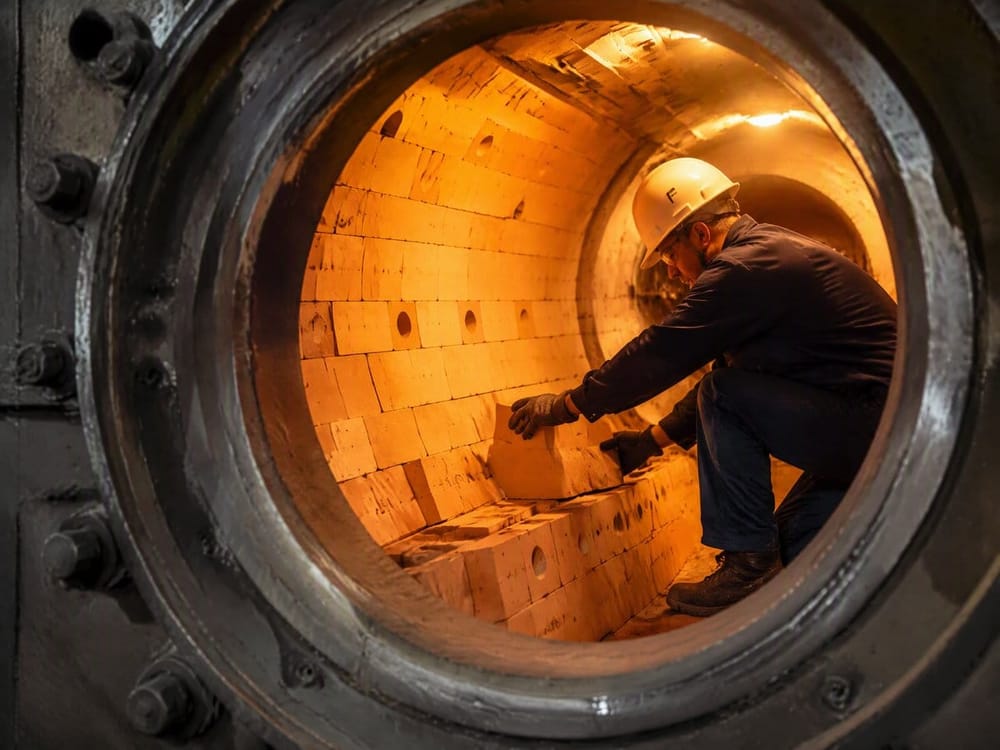
Refractories & Lining Service
A kiln lining is not just a layer of bricks. It must survive 850–950°C with steam and alkaline ash for three to five years, and absorb the thermal shock of every start and stop. When a lining fails early, the cause is usually not the brick but the expansion joints and anchors. Scope Kiln shell brickwork including special shapes, insulation design, anchor and mesh installation, castable placement, and dry-out schedule development and execution — for activation kilns, carbonisers, rotary kilns and incinerators. Three critical zones The activation zone (high temperature, steam, abrasive solids — high-alumina brick or corundum castable, judged on wear and steam oxidation; its life sets the overhaul interval for the whole kiln). Transition zones and expansion joints (different materials expand differently; joint width is calculated per material and run length, and the wrong filler cracks the brickwork). The discharge zone (steepest thermal gradient, low-cement castable with a controlled heat-up). Why dry-out cannot be skipped Castables contain 8–12% free and chemically bound water. Heat too fast and the water turns to steam inside the lining and spalls it. The standard schedule — 25–30°C/h to 150°C and hold 8 h, then 50°C/h to 350°C and hold 6 h, then follow the kiln — takes five to seven days. When to reline Any one of: shell temperature above 120°C, through-cracks at joints, or discharge opening deformed by more than 5%. Running until the shell glows costs two to three times a planned shutdown.