
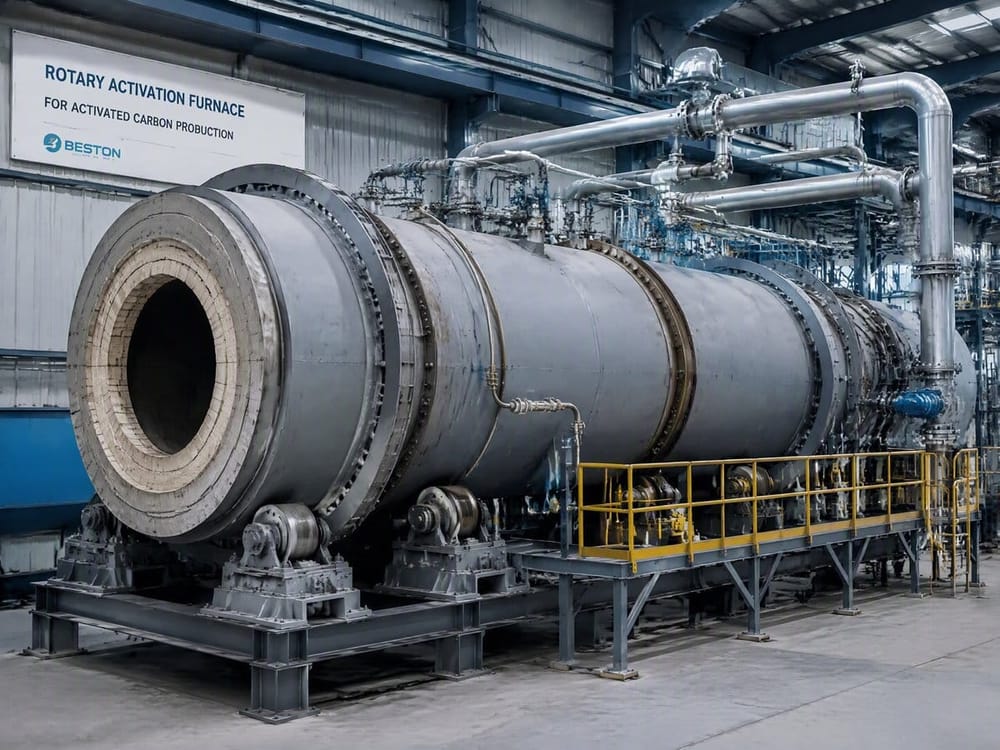
Rotary Activation Furnace
The rotary activation furnace uses a slightly inclined drum. Char enters at the high end; the drum turns at 0.5–2 r/min and internal flights lift and cascade the material through a counter-current flow of 850–950°C steam. Residence time is set by rotation speed and inclination, typically 60–120 minutes — much shorter than a vertical Slep furnace. Capacity is 0.5–3 t/h, the widest band in the range. The drum tolerates a broader feed spectrum (granular, cylindrical, crushed) and a grade change takes a few hours of cleaning rather than the 3–5 days a vertical kiln needs. Choosing between rotary and Slep Continuous single-grade duty with heat efficiency priority → Slep. Multi-grade switching, above 2 t/h, or unstable feed size → rotary. At equal capacity the rotary unit needs more floor space and loses slightly more heat, but is far more forgiving to operate and service. Design points that decide performance Flight profile (spiral for sticky feed, sector for granular — the wrong choice causes ring formation); staged steam injection in 3–4 zones, which narrows iodine-value spread by 20–30 mg/g; discharge cooling designed to ≤80°C with margin, since running 10% over rating pushes outlet temperature to 90–110°C and breaks packing; and rotary seals at both ends, the usual source of steam loss. Yield reference (coconut shell): 6.4 t wet shell at 12% moisture → 5.6 t dry → 1.68 t char (30%) → 1.04 t activated carbon (62%) → 1.00 t product. Overall yield 15.7%, i.e. 6.2–6.6 t shell per tonne of product.
Products in This Category
HRS Rotary Activation Furnace
Internal-heated rotary activation furnace for continuous activation of coal, wood and nut-shell charcoals, with uniform activation, large capacity and low energy consumption.
View Details →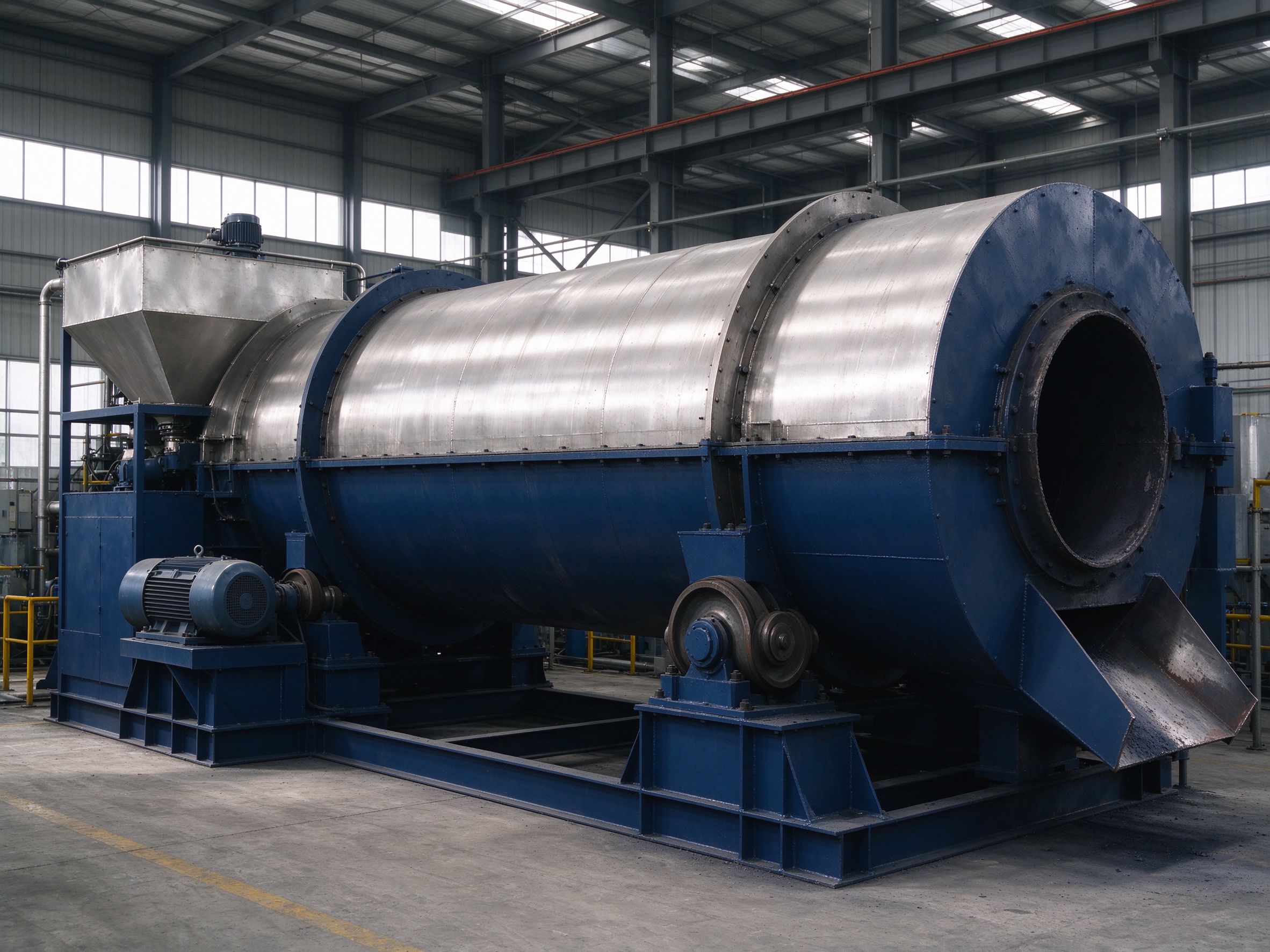
HRS Spent Activated Carbon Regeneration Furnace
Rotary regeneration furnace for spent activated carbon recovery, restoring adsorption via steam activation with high regeneration yield for water, chemical and food decolorization applications.
View Details →