GB/T 47051-2026 Takes Effect: A Renewal Window for Spent Activated Carbon Regeneration Equipment
The disposal of spent activated carbon in China has moved from "no standard to follow" to "a standard to comply with". GB/T 47051-2026, the country's first systematic national standard for the thermal regeneration of spent activated carbon, took effect on 1 August 2026. For operators of existing regeneration equipment it is both a compliance baseline and a renewal window: the standard makes automated temperature control, enclosed negative-pressure operation, energy consumption limits, regenerated carbon quality, emission control and operational data logging mandatory requirements. Simple kilns run on operator experience no longer qualify.
This article reviews the core requirements, compares how mainstream regeneration kiln types adapt to them, and outlines three practical response paths.
1. Why This Standard Directly Affects Equipment Selection
Spent activated carbon has long sat at the intersection of hazardous waste management and resource recovery. On one hand, saturated carbon is solid or even hazardous waste, expensive to landfill and land-intensive. On the other, its carbon skeleton remains intact, and thermal regeneration can restore much of its adsorption capacity — it is a genuinely recyclable material.
The problem was the absence of a unified technical specification. The same spent carbon could produce very different results at different plants, with no comparable basis for iodine value recovery, carbon loss rate or off-gas emissions, and no clear reference for environmental impact assessment and project acceptance. GB/T 47051-2026 links regeneration procedures, process requirements, pollutant emissions and testing/verification methods into a complete chain, covering granular and powdered carbon derived from wood, coal and synthetic materials.
For equipment suppliers and users, this means a spent carbon regeneration kiln has shifted from "it burns, therefore it works" to "it must be able to prove compliance".
2. Core Requirements the Standard Sets for Thermal Regeneration Kilns
Broken down to the equipment level, the requirements fall into six dimensions:
| Dimension | Direction of the standard | Direct impact on equipment |
|---|---|---|
| Temperature control | Automated temperature control capable of staged adjustment based on the material's thermal weight-loss characteristics | Kilns controlled manually no longer have a compliance basis |
| Vessel structure | Enclosed, negative-pressure operation with controlled collection of process off-gas | Open or positive-pressure vessels require retrofit |
| Energy consumption | Regeneration energy consumption limits; energy-efficient heating processes encouraged | Operating costs of high-consumption externally heated units rise further |
| Regenerated quality | Reliable desorption and decomposition of pollutants; iodine value, methylene blue value and other indicators of regenerated carbon meet specification | Requires repeatable, verifiable process — not occasional compliance |
| Emission control | Off-gas discharged to standard; prevention of fugitive VOC emissions | Off-gas treatment system becomes mandatory and must run reliably |
| Data traceability | Full-process operational data collection to support environmental inspection and product traceability | Requires automation and data logging capability |
One easily overlooked item is traceability. Environmental inspections no longer rely on a single instantaneous test report; they examine whether the operating log is continuous and complete. That directly determines whether a DCS or data acquisition system is needed.
3. How Mainstream Regeneration Kiln Types Adapt
Three kiln types dominate industrial spent carbon regeneration, and their compliance fit differs noticeably:
| Dimension | Rotary kiln | Multi-hearth furnace | Microwave regeneration |
|---|---|---|---|
| Heating method | Combined internal/external heating; material tumbles through a rotating shell | Layer-by-layer raking across multiple hearths; indirect heating | Microwaves act on polar substances inside the carbon; internal heating |
| Suitable scale | Medium to large, 1,000–20,000 t/a | Large, above 5,000 t/a | Small to medium; suited to skid-mounted, distributed deployment |
| Temperature uniformity | Good, depends on shell geometry and rotation design | Good, controllable hearth by hearth | Good, no cold-core problem |
| Carbon loss rate | 3%–8% depending on process and operation | 4%–8% | As low as about 3% |
| Energy consumption | Moderate; flue gas waste heat recoverable | Medium to high | Relatively low; fully electric |
| Suitability for powdered carbon | Fair; prone to dusting and ringing | Fair | Good |
| Key compliance points | Requires off-gas treatment and automated temperature control | Requires off-gas treatment and data logging | Requires solutions for scale and single-unit capacity limits |
Industry research indicates that thermal regeneration kilns and off-gas treatment upgrades accounted for more than 55% of global investment in new regeneration facilities during 2025–2026, while the sector's average carbon loss rate is around 5%–8%, with advanced facilities achieving 3%–4%. Every one percentage point reduction in carbon loss translates into hundreds of tonnes of material for a regeneration centre handling 10,000 tonnes per year.
4. Three Practical Response Paths
Path 1: Assess existing units for compliance first. Check three things: whether the vessel is enclosed and under negative pressure, whether temperature control is automated and recordable, and whether off-gas is collected and treated. If two or more are missing, retrofitting is usually less economic than replacing.
Path 2: Specify new projects to the standard. Write "automated temperature control + enclosed negative pressure + off-gas treatment + data logging" into the technical agreement as base scope rather than future add-ons. This is the stage where environmental assessment and acceptance most often stall.
Path 3: Regional regeneration centre model. For companies with high carbon consumption spread across many sites, a single small on-site unit is rarely economic. A centralised 3,000–20,000 t/a regeneration centre combined with a collection network lowers unit processing cost and makes it far easier to meet the standard's traceability and emission requirements.
5. Frequently Asked Questions
Q1: Which spent activated carbons does GB/T 47051-2026 cover?
It applies to the thermal regeneration of spent granular and powdered carbon derived from wood, coal and synthetic materials, covering regeneration procedures, process requirements, pollutant emissions, and testing and verification methods.
Q2: What level of iodine value can regenerated carbon reach?
It depends on the original quality of the spent carbon, the pollutant load and the regeneration process. With stable process control, granular carbon can reach a high iodine value recovery while remaining consistent batch to batch. Consistency — not occasional peaks — is what matters.
Q3: What carbon loss rate is considered normal?
The industry average is around 5%–8%, and facilities with better process and equipment can achieve 3%–4%. The rate is strongly influenced by heating method, residence time and atmosphere control.
Q4: Can a rotary kiln regeneration unit meet the new standard?
Yes, provided it has automated temperature control, an enclosed negative-pressure structure and a complete off-gas treatment system. Older rotary kilns missing these features must be retrofitted first.
Q5: How long does retrofitting an existing regeneration unit take?
It depends on scope. A retrofit focused on vessel enclosure, temperature control and off-gas treatment typically takes weeks to months and should be scheduled around production. A compliance assessment should come first.
6. Songrui's Spent Carbon Regeneration Equipment
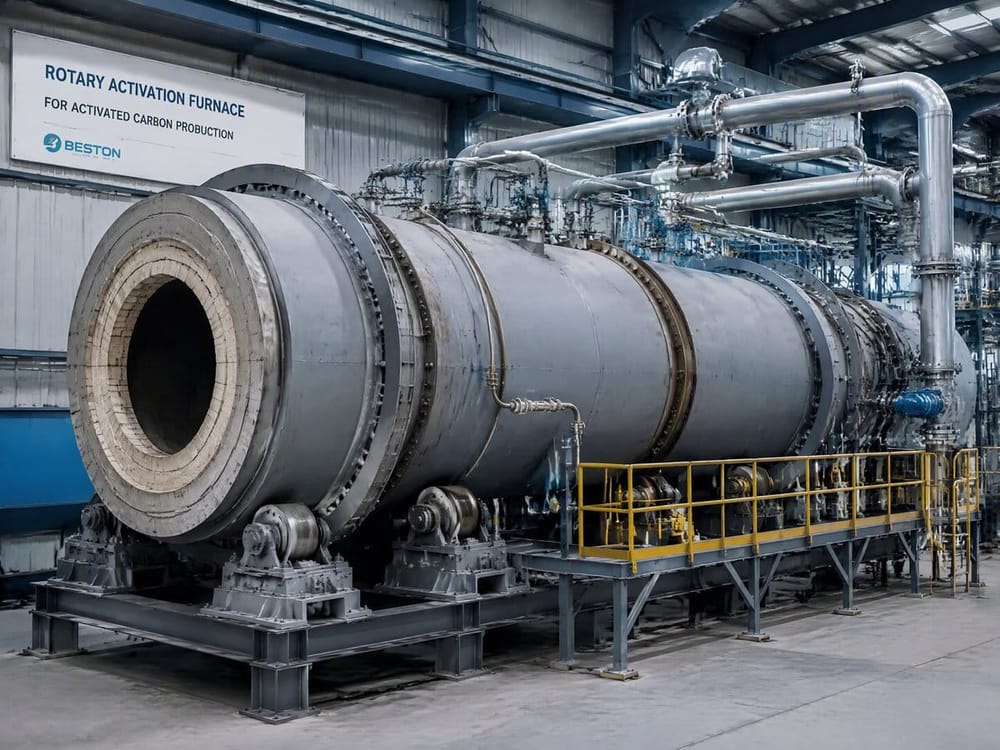
Henan Songrui New Refractory Materials supplies rotary spent activated carbon regeneration kilns and complete regeneration systems designed around GB/T 47051-2026: enclosed negative-pressure vessels, staged automatic temperature control, flue gas waste heat recovery, and integrated quenching, scrubbing and off-gas treatment — with full-process data logging and log output. Kiln lining refractories come from our own production line, and we also undertake vessel overhauls and compliance retrofits of existing units.
If your regeneration equipment is under compliance assessment, send us the kiln type, processing scale and current process — we will provide a targeted selection and retrofit recommendation.